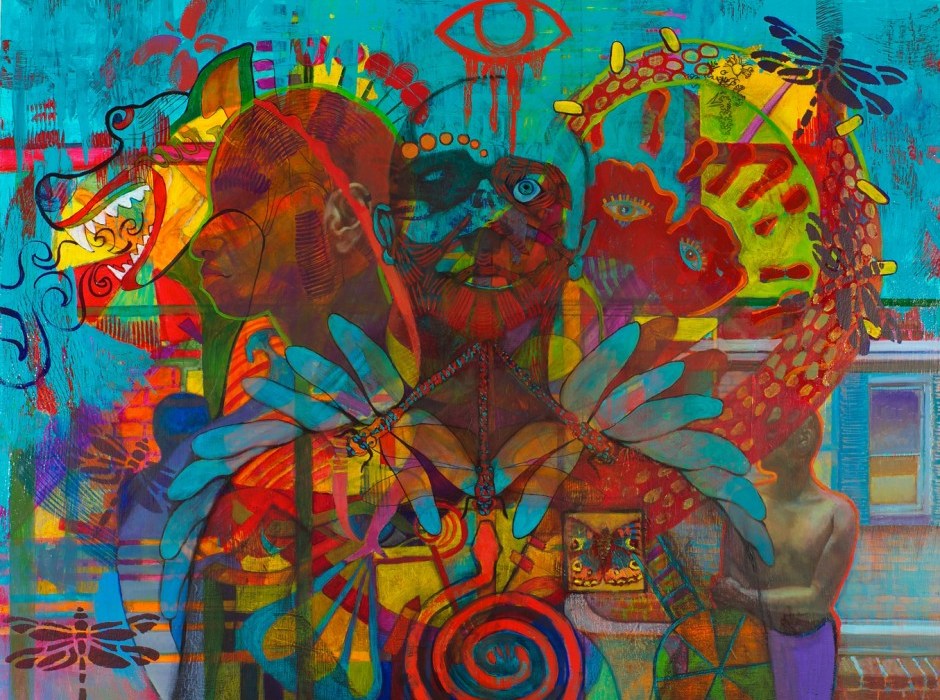
Welcome back! I am really excited about this post, so let’s get started. I have created a video for you to see please click here for access. In the video I discuss how textual analysis and remediation work together, what it can look like in the classroom, and how I have used it in my classroom before (I have attached the texts and chosen other medium to this post for you to see). In this post, I am going to discuss the choices, process, and topic that all lead to the creation of my product (the video). I will also be drawing on Jones and Hafner, Understanding Digital Literacies, and the use of multimodality both in the classroom and with my product. (Note: in the video I mention an example of textual analysis and remediation that worked in my class. The picture set with this post is the art I used to remediate the texts found here entitled “what a piece of work is man.” This was designed as an introduction lesson to Antigone.)
For this product, I used Photo Booth on my Mac (which I had never used or even tinkered with until today – truth! I usually use an online tool, but there are a ton of free video tools online as well), and I uploaded it to my Google Drive in order to share it with you. In order to create a video, be sure to have a quiet work space (no background noise) to help your viewers be able to hear you. The Photo Booth app was already downloaded on my Mac, but you can also download it from an apple App Store. For those of you who are using a PC, do not fret. There are several free video tools you can download and I am going to list some right here for you:
- Animoto
- Camstudio
- Soapbox
- Clipchamp
- Screencast-O-Matic (yes, you can use it just to record yourself and not the screen)
I know what you are thinking “a video…isn’t that rather simplistic?” First off, there is NOTHING simplistic about making a video. Your computer usually starts running slow so your video starts skipping, you have to use the bathroom, a cat gets in the way and absolutely will not move (actually happened during my first recording), etc. The complications are infinite. You also have to learn how to work the tool in order to get your video made. If your video is kept online, then you have to figure out how to share it, and if your video was made in an app on your computer, then you have to get it to a database that you can share it from. Videos can also be very intricate. I am still practicing using video programs and tools, but there are ways to upload images and piece other videos together to create a unique work. I kept this product pretty simple. The task was to think about a topic (textual analysis and remediation) and discuss it with you and my own take on the topic (textual analysis and remediation). I believe I could do that best by talking to you myself, and luckily I had a tool on my computer to help me do just that.
This tool allowed me to video for as long as I need to (luckily for you it was only 6 minutes). Now, if you choose to use a different video tool, then you may have some time constraints. Photo booth also affords me the option to put filters over my face and in the background, but for this video I did not choose to do that. I thought it would be distracting. When we make videos for our students, we should keep in mind when is a good time and when is a bad time to use those special features. Will it distract my student from any important information they need to know right now? That is usually the main question I ask myself. This app can only be downloaded to Apple Products which is great for an Apple user like myself but not so great for the sad PC users. It can also make it difficult to share with others which is one reason I needed to upload it to Google Drive.
It was interesting how the topic for my product and the Jones and Hafner reading (Chapter Four in Understanding Digital Literacies) went so well together. Jones and Hafner discuss the importances and intricacies of using and implementing multimodal practices in the classroom. Text analysis with remediation is an excellent way to work in a multimodal text. Jones and Hafner write, “Images tend to have a more direct effect, often provoking an immediate emotional reaction from viewers” (52). This quote aligns perfectly with what I stated in my video. The students are able to see what their teacher or peers are seeing by being able see (or hear) a visual (or hear an audio) that allows to have insight and better understand someone else’s take.
Jones and Hafner also discuss the usage of video blogging as a source of multimodal content. (Multimodal=the combination of multiple modes – aural, visual, verbal, textual.) Now, I am not saying this video should be classified as a video blog; however, it could be used for it. I use myvoice to discuss a topic rather than writing about it. Jones and Hefner state, “In terms of multimodal content, digital stories and video blogs can vary from simple creations to semi-professional movie-like productions” (58). What can we take away from this quote? Well let’s look back at my video for a minute. (Let us pretend it is part of a video blog). It is a simple video discussing a topic for an audience online. It is also incorporates aural and visual processing for the audience which does make the product multimodal.
Why is multimodality important? Let’s refer back to Richard Mayer, the father of the Cognitive Theory of Multimedia Learning, who said people learn more deeply from words and pictures than just from words alone. His theory encompasses this belief that students learn will develop a deeper understanding of given information when dual-processing is in work. The practice of incorporating multimodal content and text in our classes to help students understand and interact with new information will be beneficial because of the multimodal processing that is happening. When we use multimodal content, a video for instance (one much more engaging than mine of course – we are talking about keeping middle and high school students focused on the content here), we are encompassing practices that (at least this is my goal) promote interaction and involvement from our students.
What other ways would you, as a teacher, encompass multimodality into your classroom with content and texts?
 Digitally Diverse